KRI NEWS
EXECUTIVE CERTIFICATE IN STRATEGIC SCHOOL LEADERSHIP & GOVERNANCE
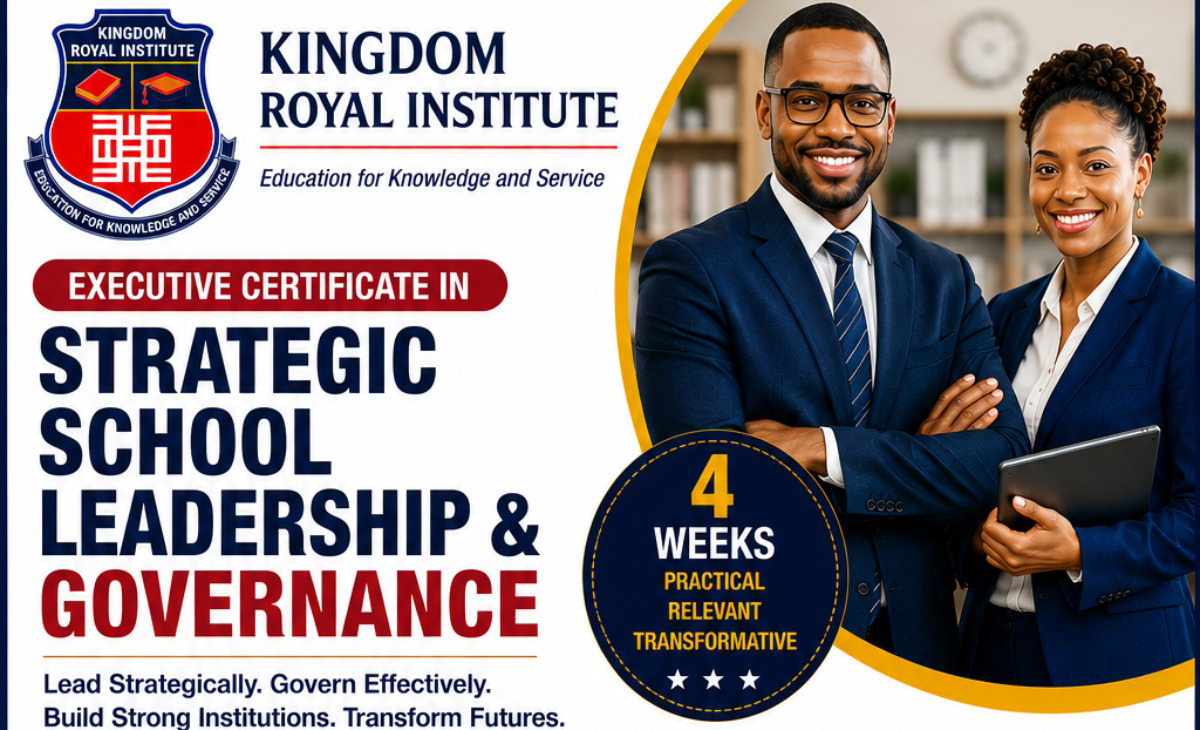
EXECUTIVE CERTIFICATE IN STRATEGIC SCHOOL LEADERSHIP & GOVERNANCE
Course Description
The Executive Certificate in Strategic School Leadership & Governance is designed to equip current and aspiring educational leaders with the knowledge and practical skills required to provide strategic direction, promote good governance and improve institutional performance.
The programme focuses on strategic leadership, school governance, accountability, policy implementation, ethical leadership, risk management, institutional performance, stakeholder engagement and change management.
Participants will also explore how Artificial Intelligence, data analytics and digital technologies can support strategic planning, institutional monitoring, decision-making and governance.
The programme uses practical case studies and school-based scenarios, with particular attention to the realities of educational institutions in Ghana.
1. Programme Overview
|
Item |
Details |
|
Institution |
Kingdom Royal Institute (KRI) |
|
Programme |
Executive Certificate in Strategic School Leadership & Governance |
|
Duration |
4 Weeks |
|
Frequency |
3 Sessions per Week |
|
Total Sessions |
12 |
|
Session Duration |
2 Hours |
|
Total Contact Hours |
24 Hours |
|
Mode of Delivery |
Online / Blended |
|
Level |
Executive Professional Development |
|
Award |
KRI Executive Certificate |
|
Fee |
GHC1500.00 |
|
Assessment |
Practical activities, assignments, case studies and final project |
2. Course Description
The Executive Certificate in Strategic School Leadership & Governance is designed to equip current and aspiring educational leaders with the knowledge and practical skills required to provide strategic direction, promote good governance and improve institutional performance.
The programme focuses on strategic leadership, school governance, accountability, policy implementation, ethical leadership, risk management, institutional performance, stakeholder engagement and change management.
Participants will also explore how Artificial Intelligence, data analytics and digital technologies can support strategic planning, institutional monitoring, decision-making and governance.
The programme uses practical case studies and school-based scenarios, with particular attention to the realities of educational institutions in Ghana.
3. Rationale
Effective schools require more than good administration. They require leaders who can establish a clear direction, allocate resources strategically, promote accountability, manage risks and create systems that support sustainable institutional improvement.
School leaders also operate within a network of stakeholders, including school owners, boards, teachers, parents, students, communities, regulators and education authorities.
The programme therefore develops the strategic and governance competencies required to lead educational institutions responsibly and sustainably in an increasingly digital environment.
4. Programme Aim
The programme aims to develop strategic, ethical, accountable and technology-aware educational leaders capable of strengthening school governance, improving institutional performance and leading sustainable organisational change.
5. Programme Objectives
By the end of the programme, participants should be able to:
- Explain the principles of strategic educational leadership.
- Understand the structures and functions of school governance.
- Develop institutional strategic priorities and goals.
- Promote accountability and transparency.
- Apply ethical principles to educational leadership.
- Identify and manage institutional risks.
- Use performance indicators to monitor school performance.
- Engage boards, parents, teachers and other stakeholders effectively.
- Manage organisational change strategically.
- Use AI and digital tools to support strategic planning and governance.
- Develop practical governance and institutional improvement strategies.
6. Learning Outcomes
Participants will be able to:
- Apply strategic leadership principles to educational institutions.
- Develop a basic school strategic plan.
- Explain the roles of governing bodies and school leadership.
- Establish accountability mechanisms.
- Identify ethical issues in school management.
- Conduct basic institutional risk assessments.
- Develop appropriate performance indicators.
- Analyse institutional performance information.
- Engage key stakeholders strategically.
- Use AI and technology to support governance and decision-making.
- Develop a practical school governance improvement project.
7. Target Participants
The programme is suitable for:
- School proprietors
- Headteachers
- Assistant headteachers
- School board members
- Governing council members
- School administrators
- Heads of departments
- Education officers
- Teachers aspiring to leadership
- Education consultants
- NGO education managers
- Private school managers
- Educational entrepreneurs
8. Entry Requirements
Applicants should normally possess:
- A minimum of SHS certificate or equivalent; and
- Relevant professional, educational, administrative or work experience where applicable.
Applicants with higher qualifications or substantial professional experience may also be considered.
9. Programme Structure
MODULE 1
Strategic Educational Leadership
MODULE 2
School Governance & Accountability
MODULE 3
Risk, Ethics & Institutional Performance
MODULE 4
Stakeholder Leadership, Change & Digital Governance
10. Detailed Course Outline
MODULE 1: STRATEGIC EDUCATIONAL LEADERSHIP
Session 1: Strategic Leadership in Education
Topics
- Meaning of strategic leadership
- Strategic leadership versus operational management
- Role of the strategic school leader
- Strategic thinking in education
Practical
Activity:
Analyse the strategic challenges facing a typical Ghanaian school.
Session 2: Vision, Mission & Strategic Planning
Topics
- Vision and mission
- Institutional values
- Strategic objectives
- Priority setting
- SWOT analysis
Practical
Activity:
Develop a school vision, mission and three strategic objectives.
Session 3: AI, Data & Strategic Decision-Making
Topics
- Data-driven leadership
- Using school data for decisions
- Introduction to AI-supported decision-making
- AI-assisted strategic planning
- Responsible use of AI in leadership
Practical
Activity:
Use an AI tool to analyse a hypothetical school performance problem.
MODULE 2: SCHOOL GOVERNANCE & ACCOUNTABILITY
Session 4: Principles of School Governance
Topics
- Meaning of educational governance
- Governance versus management
- Governance structures
- Roles and responsibilities
- Good governance principles
Practical
Activity:
Map the governance structure of a school.
Session 5: Accountability, Transparency & Ethical Leadership
Topics
- Accountability in education
- Transparency
- Ethical leadership
- Professional conduct
- Conflict of interest
Practical
Activity:
Analyse an ethical dilemma involving a school leader.
Session 6: Policy, Compliance & Institutional Responsibility
Topics
- School policies
- Policy implementation
- Institutional responsibilities
- Regulatory compliance
- Record keeping and documentation
- Digital policy management
Practical
Activity:
Review a sample school policy and identify areas for improvement.
MODULE 3: RISK, ETHICS & INSTITUTIONAL PERFORMANCE
Session 7: Risk Management in Educational Institutions
Topics
- Meaning of institutional risk
- Types of school risks
- Risk identification
- Risk assessment
- Risk mitigation
Practical
Activity:
Develop a basic school risk register.
Session 8: Institutional Performance & Quality
Topics
- Institutional performance
- Key Performance Indicators (KPIs)
- Monitoring performance
- School performance data
- Continuous improvement
Practical
Activity:
Develop five KPIs for a school.
Session 9: Digital Governance & Technology Risk
Topics
- Digital governance
- School information systems
- Data protection
- Cybersecurity awareness
- Technology risks
- AI governance
Practical
Activity:
Identify major technology risks in a school and propose controls.
MODULE 4: STAKEHOLDER LEADERSHIP, CHANGE & DIGITAL TRANSFORMATION
Session 10: Stakeholder Leadership & Engagement
Topics
- Identifying school stakeholders
- Stakeholder expectations
- Parent engagement
- Board/SMC/PTA relationships
- Community partnerships
Practical
Activity:
Develop a school stakeholder engagement plan.
Session 11: Leading Change & Institutional Transformation
Topics
- Why organisations change
- Managing resistance
- Change leadership
- Digital transformation
- Educational innovation
- AI-enabled transformation
Practical
Activity:
Develop a change-management plan for introducing a new technology in a school.
Session 12: Strategic Governance Project & Presentation
Participants will develop and present a:
School Strategic Governance & Improvement Project
The project should include:
- Institutional challenge
- Current situation
- Strategic objective
- Governance issue
- Risk considerations
- Stakeholder analysis
- Technology/AI opportunity
- Action plan
- Performance indicators
- Expected results
11. Teaching & Learning Methods
The programme will use:
- Interactive lectures
- Case studies
- Group discussions
- Leadership scenarios
- Problem-solving exercises
- Role plays
- AI demonstrations
- Data exercises
- Policy analysis
- Presentations
- Practical projects
12. Assessment
|
Assessment Component |
Weight |
|
Participation & practical activities |
10% |
|
Individual assignments |
20% |
|
Case study analysis |
15% |
|
Group presentation |
15% |
|
Strategic governance project |
30% |
|
Final presentation |
10% |
|
Total |
100% |
13. Final Project
Participants will develop a Strategic Governance & Institutional Improvement Project.
Possible projects include:
- School Strategic Plan
- School Governance Improvement Plan
- School Risk Management Plan
- Digital Governance Plan
- AI Governance Framework for a School
- Stakeholder Engagement Strategy
- School Accountability Framework
- School Performance Improvement Plan
14. Certification Requirements
Participants must:
- Attend at least 80% of sessions.
- Complete required assignments.
- Participate in practical activities.
- Complete the final project.
- Present the project.
- Achieve the required overall pass mark.
15. Graduate Profile
Graduates should be able to:
Provide strategic direction, strengthen governance, promote accountability, manage institutional risks, engage stakeholders and use data, AI and technology to improve educational institutions.