KRI NEWS
EXECUTIVE CERTIFICATE IN HUMAN RESOURCE MANAGEMENT IN EDUCATION
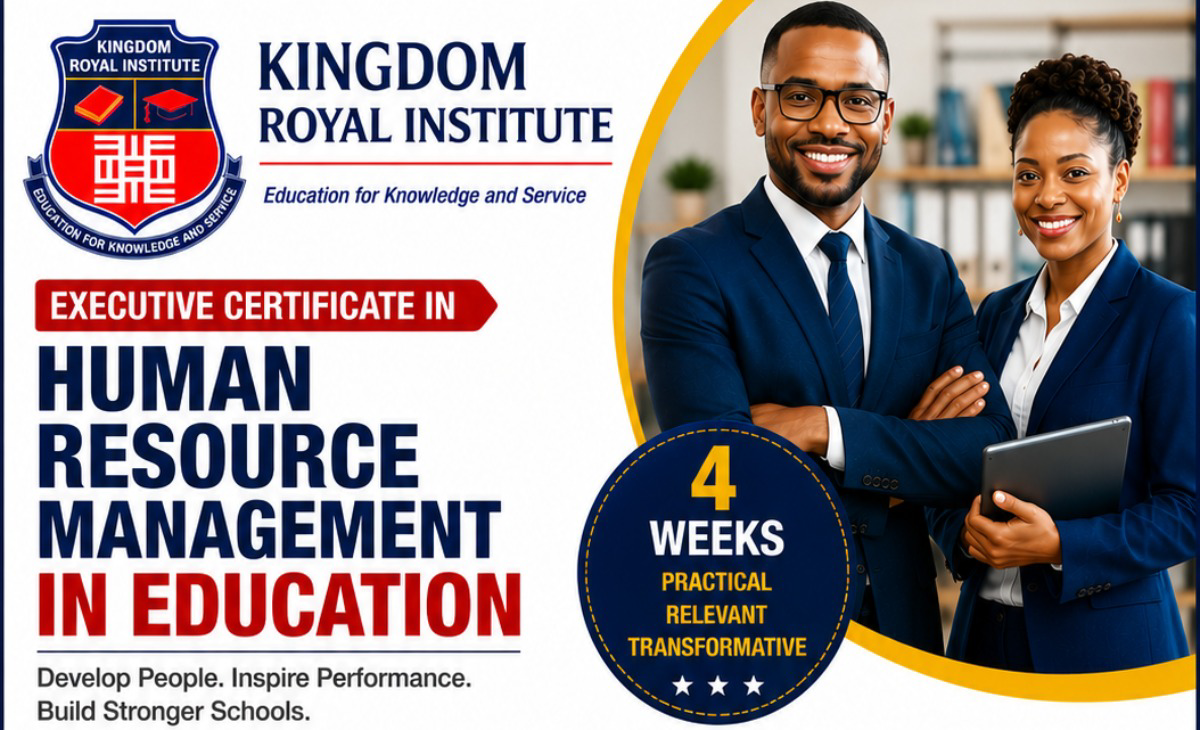
EXECUTIVE CERTIFICATE IN HUMAN RESOURCE MANAGEMENT IN EDUCATION
Course Description
The Executive Certificate in Human Resource Management in Education is a practical professional development programme designed to equip school leaders, administrators and education professionals with the knowledge and skills required to effectively manage people in educational institutions.
The programme focuses on staff recruitment, selection, induction, motivation, performance management, professional development, employee relations, conflict management, staff welfare and retention.
It also introduces participants to the use of Artificial Intelligence (AI), digital HR tools and data to improve recruitment, staff development, performance management and administrative decision-making.
The programme is designed particularly for the realities of public and private schools in Ghana, where effective management of teachers and non-teaching staff is essential to institutional success.
1. Programme Overview
|
Item |
Details |
|
Institution |
Kingdom Royal Institute (KRI) |
|
Programme |
Executive Certificate in Human Resource Management in Education |
|
Duration |
4 Weeks |
|
Frequency |
3 Sessions per Week |
|
Total Sessions |
12 |
|
Session Duration |
2 Hours |
|
Total Contact Hours |
24 Hours |
|
Mode of Delivery |
Online / Blended |
|
Level |
Executive Professional Development |
|
Award |
KRI Executive Certificate |
|
Fee |
GHC1500.00 |
|
Assessment |
Practical activities, assignments, case studies and HR improvement project |
2. Course Description
The Executive Certificate in Human Resource Management in Education is a practical professional development programme designed to equip school leaders, administrators and education professionals with the knowledge and skills required to effectively manage people in educational institutions.
The programme focuses on staff recruitment, selection, induction, motivation, performance management, professional development, employee relations, conflict management, staff welfare and retention.
It also introduces participants to the use of Artificial Intelligence (AI), digital HR tools and data to improve recruitment, staff development, performance management and administrative decision-making.
The programme is designed particularly for the realities of public and private schools in Ghana, where effective management of teachers and non-teaching staff is essential to institutional success.
3. Rationale
Teachers and other employees are among the most important resources of an educational institution. Poor recruitment, inadequate staff development, weak performance management and unresolved workplace conflicts can negatively affect school performance.
School leaders therefore need practical HR competencies to attract, develop, motivate, evaluate and retain effective staff.
The increasing availability of AI and digital HR tools also provides opportunities to make HR processes more efficient, while creating new responsibilities relating to fairness, privacy and ethical decision-making.
4. Programme Aim
The programme aims to develop competent, ethical and technology-aware education managers who can effectively manage, develop and motivate staff to improve institutional performance.
5. Programme Objectives
By the end of the programme, participants should be able to:
- Explain the principles of human resource management in education.
- Identify effective approaches to staff recruitment and selection.
- Develop appropriate staff induction and onboarding processes.
- Apply strategies for staff motivation and retention.
- Manage employee performance effectively.
- Develop practical staff training and professional-development plans.
- Handle workplace communication and conflict constructively.
- Promote staff welfare and positive organisational culture.
- Apply basic HR data and digital tools.
- Use AI responsibly in selected HR activities.
- Develop an HR improvement strategy for an educational institution.
6. Learning Outcomes
At the end of the programme, participants will be able to:
- Develop a basic recruitment and selection process.
- Prepare job descriptions and person specifications.
- Design staff induction programmes.
- Apply practical employee motivation strategies.
- Conduct effective performance discussions.
- Develop individual staff-development plans.
- Address workplace conflicts appropriately.
- Promote staff wellbeing and positive school culture.
- Use digital tools for HR administration.
- Apply AI responsibly in recruitment, training and HR planning.
- Develop a practical HR improvement plan.
7. Target Participants
The programme is suitable for:
- Headteachers
- Assistant headteachers
- School proprietors
- School administrators
- Human resource officers
- Teachers
- Heads of departments
- Education officers
- School supervisors
- NGO education managers
- Training and development officers
- Private school managers
- Educational consultants
- Professionals aspiring to HR leadership roles
8. Entry Requirements
Applicants should normally possess:
- A minimum of SHS certificate or equivalent; and
- Relevant educational, professional, administrative or work experience where applicable.
Applicants with higher qualifications may also be considered.
9. Programme Structure
MODULE 1
HR Foundations, Workforce Planning & Recruitment
MODULE 2
Staff Induction, Motivation & Employee Relations
MODULE 3
Performance Management & Professional Development
MODULE 4
HR Technology, AI & Workplace Improvement
10. Detailed Course Outline
MODULE 1: HR FOUNDATIONS, WORKFORCE PLANNING & RECRUITMENT
Session 1: Human Resource Management in Education
Topics
- Meaning of HR management
- Importance of people management in schools
- Roles of education managers in HR
- Workforce planning
- Teacher and staff responsibilities
Practical
Activity:
Identify the major HR challenges facing a typical school.
Session 2: Recruitment & Selection
Topics
- Identifying staffing needs
- Job descriptions
- Person specifications
- Recruitment methods
- Interviewing
- Selection and appointment
Practical
Activity:
Develop a job description and interview questions for a teaching position.
Session 3: AI & Digital Recruitment
Topics
- Digital recruitment
- Online applications
- AI-assisted job descriptions
- AI-assisted candidate screening
- Risks of algorithmic bias
- Data privacy and ethical recruitment
Practical
Activity:
Use an AI tool to develop a recruitment package while identifying potential AI
risks.
MODULE 2: STAFF INDUCTION, MOTIVATION & EMPLOYEE RELATIONS
Session 4: Staff Induction & Onboarding
Topics
- Meaning and purpose of induction
- Orientation programmes
- School policies
- Role expectations
- Mentoring
- Probation and early support
Practical
Activity:
Design a one-week induction programme for newly appointed teachers.
Session 5: Staff Motivation & Retention
Topics
- Meaning of employee motivation
- Factors affecting teacher motivation
- Recognition and rewards
- Career development
- Employee engagement
- Staff retention
Practical
Activity:
Develop a practical teacher motivation strategy for a school.
Session 6: Employee Relations & Conflict Management
Topics
- Workplace relationships
- Causes of staff conflict
- Communication problems
- Conflict-resolution approaches
- Negotiation and mediation
- Building a positive school culture
Practical
Activity:
Analyse and resolve a workplace conflict case.
MODULE 3: PERFORMANCE MANAGEMENT & PROFESSIONAL DEVELOPMENT
Session 7: Staff Performance Management
Topics
- Meaning of performance management
- Setting performance expectations
- Performance indicators
- Performance reviews
- Constructive feedback
Practical
Activity:
Develop basic performance indicators for a teacher.
Session 8: Staff Training & Professional Development
Topics
- Identifying training needs
- Professional development planning
- Coaching
- Mentoring
- Continuing professional development
- Evaluating training outcomes
Practical
Activity:
Develop a staff professional-development plan.
Session 9: AI & Data-Driven HR Management
Topics
- HR data
- Staff performance information
- Workforce analytics
- AI-assisted HR planning
- Identifying staffing trends
- Ethical use of employee data
Practical
Activity:
Analyse a sample staff dataset and identify two HR priorities.
MODULE 4: HR TECHNOLOGY, AI & WORKPLACE IMPROVEMENT
Session 10: Employee Welfare & Organisational Culture
Topics
- Staff wellbeing
- Work-life balance
- Employee support
- Organisational culture
- Professional ethics
- Creating a healthy workplace
Practical
Activity:
Develop a staff welfare improvement initiative.
Session 11: Digital HR & AI for Education Managers
Topics
- Digital HR systems
- Electronic employee records
- HR dashboards
- AI-assisted HR administration
- AI for staff training and communication
- Data protection
- Responsible AI use
Practical
Activity:
Design a simple digital HR workflow for a school.
Session 12: HR Improvement Project & Presentation
Participants will develop and present an:
Educational Institution HR Improvement Plan
The project should include:
- HR problem
- Current situation
- Root cause
- Proposed solution
- Staff-management strategy
- Technology/AI component
- Implementation plan
- Performance indicators
- Expected outcomes
11. Teaching & Learning Methods
The programme will use:
- Interactive lectures
- HR case studies
- Role plays
- Recruitment simulations
- Group discussions
- Problem-solving exercises
- AI demonstrations
- Digital HR activities
- Practical document preparation
- Peer learning
- Individual and group projects
12. Assessment
|
Assessment Component |
Weight |
|
Participation & practical activities |
10% |
|
Individual assignments |
20% |
|
HR case study analysis |
15% |
|
Group presentation |
15% |
|
HR improvement project |
30% |
|
Final presentation |
10% |
|
Total |
100% |
13. Final Project
Participants may develop any one of the following:
- Teacher Recruitment Improvement Plan
- Staff Induction Programme
- Teacher Motivation & Retention Strategy
- Staff Performance Management System
- Professional Development Plan
- Digital HR Management Plan
- AI-Assisted HR Strategy
- Staff Welfare Improvement Plan
- School Organisational Culture Improvement Plan
14. Certification Requirements
Participants must:
- Attend at least 80% of sessions.
- Complete required assignments.
- Participate in practical activities.
- Complete the HR improvement project.
- Present the final project.
- Achieve the required overall pass mark.
15. Graduate Profile
A successful participant should be able to:
Recruit effectively, develop and motivate staff, manage performance, resolve workplace challenges, promote staff welfare and use digital technology and AI responsibly to strengthen human resource management in educational institutions.