KRI NEWS
EXECUTIVE CERTIFICATE IN CHANGE MANAGEMENT IN EDUCATION
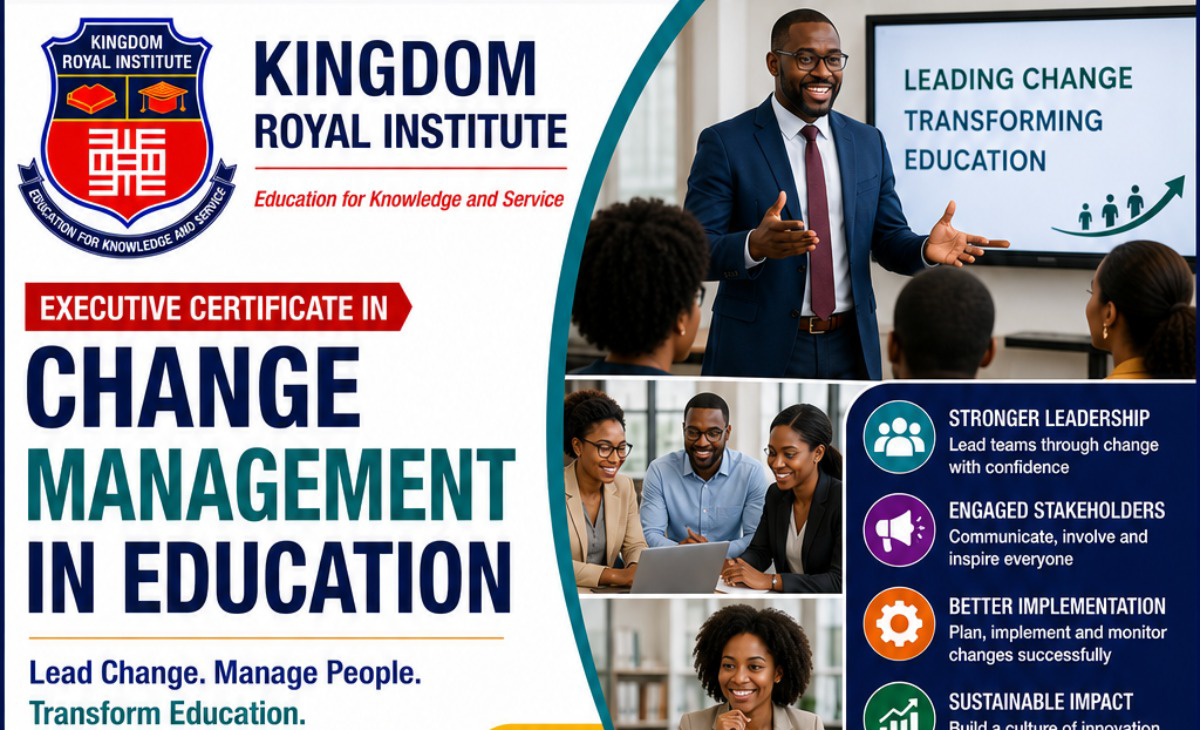
EXECUTIVE CERTIFICATE IN CHANGE MANAGEMENT IN EDUCATION
Programme Description
The Executive Certificate in Change Management in Education is designed to equip educational leaders, administrators, teachers and institutional managers with the knowledge and practical skills required to plan, lead and sustain organisational and educational change.
The programme explores why educational institutions need to change, how people respond to change, how leaders can manage resistance, and how technology and Artificial Intelligence (AI) are transforming schools and other educational organisations.
Participants will develop practical skills for managing changes involving curriculum, technology, staffing, policies, school structures, digital transformation, teaching and learning, and institutional improvement.
Programme Overview
|
Item |
Details |
|
Institution |
Kingdom Royal Institute (KRI) |
|
Programme |
Executive Certificate in Change Management in Education |
|
Duration |
4 Weeks |
|
Sessions |
3 sessions per week |
|
Total Sessions |
12 |
|
Session Duration |
2 hours |
|
Total Contact Hours |
24 hours |
|
Mode |
Online / Blended |
|
Level |
Executive Professional Certificate |
|
Fee |
GHC1500.00 |
|
Award |
KRI Executive Certificate |
Programme Theme
Leading Change. Managing People. Transforming Education.
1. Programme Description
The Executive Certificate in Change Management in Education is designed to equip educational leaders, administrators, teachers and institutional managers with the knowledge and practical skills required to plan, lead and sustain organisational and educational change.
The programme explores why educational institutions need to change, how people respond to change, how leaders can manage resistance, and how technology and Artificial Intelligence (AI) are transforming schools and other educational organisations.
Participants will develop practical skills for managing changes involving curriculum, technology, staffing, policies, school structures, digital transformation, teaching and learning, and institutional improvement.
2. Programme Aim
To develop education professionals who can effectively lead, communicate, implement and sustain change within schools and educational institutions.
3. Programme Objectives
By the end of the programme, participants should be able to:
- Explain the meaning and importance of change management in education.
- Identify major drivers of change in educational institutions.
- Analyse the impact of change on teachers, learners and other stakeholders.
- Apply recognised change-management principles and models.
- Identify and manage resistance to change.
- Develop effective communication strategies for organisational change.
- Engage stakeholders during change initiatives.
- Manage the human and organisational dimensions of change.
- Use technology and AI to support educational transformation.
- Develop practical change implementation and monitoring plans.
- Evaluate the success and sustainability of change initiatives.
4. Programme Structure
MODULE 1
Understanding Change in Education
MODULE 2
Leading People & Managing Resistance
MODULE 3
Planning & Implementing Educational Change
MODULE 4
Digital Transformation, AI & Change Management Project
5. DETAILED COURSE OUTLINE
MODULE 1: UNDERSTANDING CHANGE IN EDUCATION
Session 1: Foundations of Change Management
Topics
- Meaning of change management
- Change management in education
- Organisational change vs educational change
- Why schools and educational institutions must change
- Planned and unplanned change
- Incremental and transformational change
Practical
Activity:
Identify five major changes currently affecting educational institutions.
Session 2: Drivers of Change in Education
Topics
- Changes in educational policy
- Curriculum reforms
- Technology and digital learning
- AI and emerging technologies
- Changing learner needs
- Demographic and social changes
- Economic pressures
- Globalisation
- Quality and accountability requirements
Practical
Activity:
Develop a Change Drivers Map for a school or educational institution.
Session 3: Change Management Models
Topics
- Lewin's Three-Stage Model
- Kotter's Change Model
- ADKAR Model
- Continuous improvement
- Applying change models to education
- Choosing an appropriate change approach
Practical
Activity:
Apply one change-management model to a simulated school transformation.
MODULE 2: LEADING PEOPLE & MANAGING RESISTANCE
Session 4: Leadership and Change
Topics
- Role of educational leaders in change
- Leadership styles
- Transformational leadership
- Distributed leadership
- Change leadership vs change management
- Building a culture of innovation
- Leading through uncertainty
Practical
Activity:
Develop a leadership strategy for introducing a major change in a school.
Session 5: Understanding Resistance to Change
Topics
- Why people resist change
- Individual and organisational resistance
- Fear and uncertainty
- Loss of control
- Change fatigue
- Lack of trust
- Resistance among teachers and staff
- Identifying resistance early
Practical
Activity:
Analyse a case study involving teacher resistance to a new educational
technology.
Session 6: Communication & Stakeholder Engagement
Topics
- Communication during change
- Stakeholder identification
- Stakeholder analysis
- Consultation and participation
- Managing expectations
- Conflict management
- Building trust
- Feedback mechanisms
Practical
Activity:
Develop a Stakeholder Communication Plan for an educational change
project.
MODULE 3: PLANNING & IMPLEMENTING EDUCATIONAL CHANGE
Session 7: Change Planning
Topics
- Change vision
- Change objectives
- Needs assessment
- Gap analysis
- Change priorities
- Resource requirements
- Change implementation teams
- Roles and responsibilities
Practical
Activity:
Prepare a basic Educational Change Action Plan.
Session 8: Implementing & Managing Change
Topics
- Implementation strategies
- Change milestones
- Resource allocation
- Staff training
- Monitoring implementation
- Managing unexpected challenges
- Change champions
- Short-term wins
Practical
Activity:
Develop an implementation roadmap for a school improvement initiative.
Session 9: Monitoring, Evaluation & Sustainability
Topics
- Change indicators
- Measuring change outcomes
- Monitoring progress
- Feedback and evaluation
- Corrective action
- Institutionalising successful changes
- Continuous improvement
- Sustainability of change
Practical
Activity:
Develop a Change Monitoring & Evaluation Framework.
MODULE 4: DIGITAL TRANSFORMATION, AI & CHANGE MANAGEMENT PROJECT
Session 10: Technology, AI & Educational Transformation
Topics
- Digital transformation in education
- AI and the future of education
- Learning technologies
- Digital administration
- AI-assisted decision-making
- Technology adoption challenges
- Digital skills gaps
- Responsible AI implementation
Practical
Activity:
Assess the readiness of a school to introduce an AI-powered educational system.
Session 11: Managing Digital & AI-Driven Change
Topics
- Digital change strategy
- Technology adoption
- Staff digital competence
- Training and capacity building
- Data privacy and security
- Cybersecurity considerations
- Managing technological resistance
- Ethical and responsible AI adoption
Practical
Activity:
Develop a Digital Transformation Change Plan for an educational
institution.
Session 12: Final Change Management Project
Participants will develop and present an:
Educational Change Management Plan
The project should include:
- Institutional background
- Problem or need for change
- Drivers of change
- Stakeholder analysis
- Change objectives
- Selected change-management model
- Leadership strategy
- Communication strategy
- Resistance-management strategy
- Implementation plan
- Technology/AI considerations
- Monitoring and evaluation
- Sustainability strategy
6. Target Participants
The programme is suitable for:
- Headteachers
- Assistant headteachers
- School proprietors
- Education managers
- Teachers
- School administrators
- Education officers
- School Improvement Support Officers
- University administrators
- Department heads
- ICT coordinators
- Education consultants
- Training managers
- Education entrepreneurs
7. Assessment
|
Assessment Component |
Weight |
|
Class participation & practical activities |
15% |
|
Individual assignments |
15% |
|
Change-management case study |
15% |
|
Change implementation exercise |
15% |
|
Final Change Management Project |
30% |
|
Project presentation |
10% |
|
Total |
100% |
8. Teaching & Learning Methods
The programme will use:
- Interactive lectures
- Educational case studies
- Change-management simulations
- Group discussions
- Role plays
- Leadership scenarios
- Stakeholder-mapping exercises
- Technology demonstrations
- AI demonstrations
- Institutional change projects
Recommended 2-hour session format
20
minutes — Concept
introduction
30 minutes — Explanation and examples
30 minutes — Case study/discussion
30 minutes — Practical activity
10 minutes — Review and questions
9. Final Project Options
Participants can develop:
- School Digital Transformation Change Plan
- Curriculum Change Management Plan
- AI Adoption Change Plan for a School
- Teacher Development Change Plan
- School Administration Transformation Plan
- Change Management Plan for Implementing an LMS
- Educational Policy Implementation Change Plan
- School Improvement Change Management Plan
Recommended KRI flagship project
“Change Management Plan for Digital and AI Transformation in an Educational Institution.”
This gives the programme a strong connection to KRI's growing Education + Technology + AI portfolio.
10. Graduate Profile
A successful graduate should be able to:
Diagnose the need for change, develop a change strategy, lead stakeholders, manage resistance, implement educational transformation and use technology and AI responsibly to achieve sustainable institutional improvement.