KRI NEWS
EXECUTIVE CERTIFICATE IN EDUCATIONAL LEADERSHIP & SCHOOL MANAGEMENT
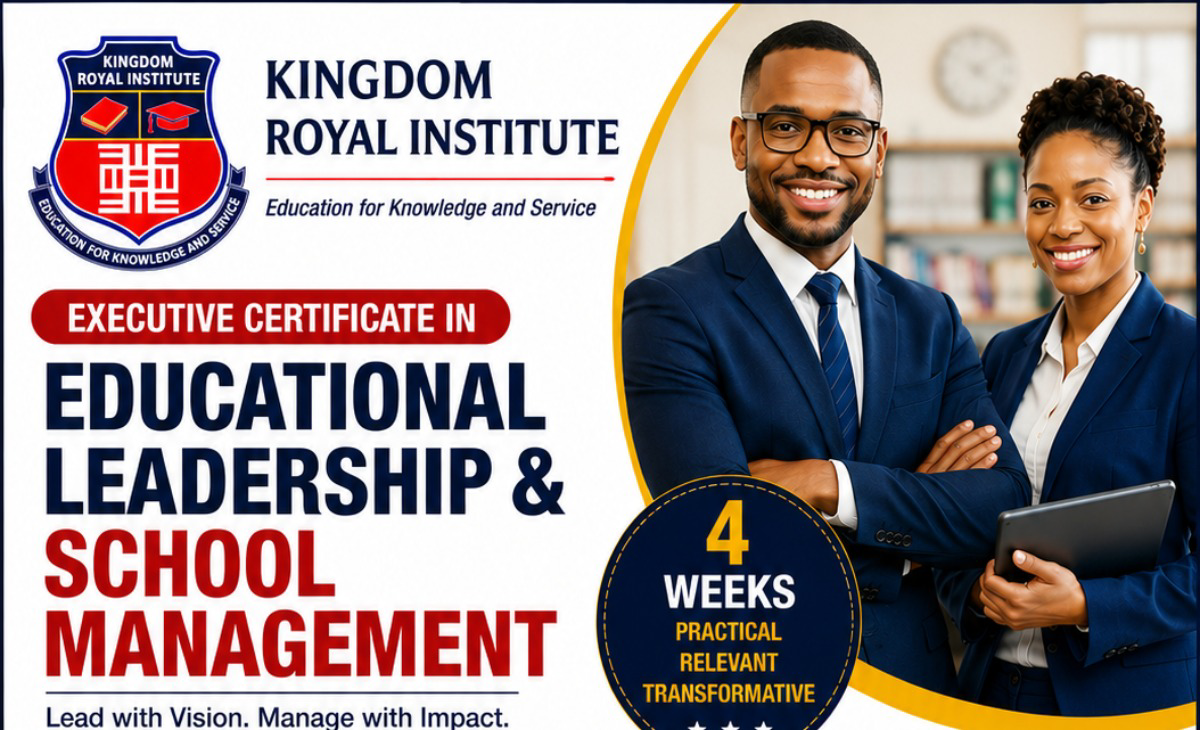
EXECUTIVE CERTIFICATE IN EDUCATIONAL LEADERSHIP & SCHOOL MANAGEMENT
Course Description
The Executive Certificate in Educational Leadership & School Management is a four-week professional development programme designed to equip current and aspiring educational leaders with practical knowledge and skills for effectively leading and managing schools and other educational institutions.
The programme focuses on essential areas of educational leadership, including leadership styles, strategic planning, school administration, human resource management, instructional leadership, financial and resource management, quality assurance, governance, stakeholder engagement, innovation and digital transformation.
The programme also introduces participants to the practical use of Artificial Intelligence (AI) and digital technologies in educational leadership, administration, decision-making and school improvement.
The programme adopts a practical, executive-oriented approach using case studies, discussions, practical exercises, role plays and school-based projects, with particular attention to challenges and opportunities within the Ghanaian educational environment.
1. Programme Overview
|
Item |
Details |
|
Institution |
Kingdom Royal Institute (KRI) |
|
Programme |
Executive Certificate in Educational Leadership & School Management |
|
Duration |
4 Weeks |
|
Frequency |
3 Sessions per Week |
|
Total Sessions |
12 |
|
Session Duration |
2 Hours |
|
Total Contact Hours |
24 Hours |
|
Mode |
Online / Blended |
|
Level |
Executive Professional Development |
|
Assessment |
Practical assignments, case studies, participation and final project |
|
Fee |
GHC1500.00 |
|
Award |
KRI Executive Certificate |
2. Course Description
The Executive Certificate in Educational Leadership & School Management is a four-week professional development programme designed to equip current and aspiring educational leaders with practical knowledge and skills for effectively leading and managing schools and other educational institutions.
The programme focuses on essential areas of educational leadership, including leadership styles, strategic planning, school administration, human resource management, instructional leadership, financial and resource management, quality assurance, governance, stakeholder engagement, innovation and digital transformation.
The programme also introduces participants to the practical use of Artificial Intelligence (AI) and digital technologies in educational leadership, administration, decision-making and school improvement.
The programme adopts a practical, executive-oriented approach using case studies, discussions, practical exercises, role plays and school-based projects, with particular attention to challenges and opportunities within the Ghanaian educational environment.
3. Rationale
Educational institutions require leaders who can do more than perform routine administrative duties. Modern educational leaders must be able to lead people, manage resources, improve teaching and learning, make informed decisions, engage stakeholders and respond to technological change.
The increasing use of Artificial Intelligence and digital technologies is also changing how schools are administered and how teaching and learning are delivered.
This programme therefore provides participants with practical leadership and management competencies while introducing them to AI, technology and data-informed approaches to school improvement.
4. Programme Aim
The programme aims to develop effective, ethical, innovative and technology-aware educational leaders who can lead schools, manage institutional resources and promote continuous improvement in teaching, learning and school performance.
5. Programme Objectives
By the end of the programme, participants should be able to:
- Explain the fundamental concepts of educational leadership and school management.
- Apply appropriate leadership styles to different school situations.
- Develop basic strategic goals and improvement plans for educational institutions.
- Manage key school administrative activities effectively.
- Apply practical approaches to staff motivation and performance management.
- Communicate effectively and manage workplace conflicts.
- Support effective teaching and learning through instructional leadership.
- Apply basic principles of school financial and resource management.
- Use quality assurance and school improvement approaches.
- Promote effective school governance and stakeholder relationships.
- Apply AI and digital technologies to selected school leadership tasks.
- Develop practical solutions to school leadership and management challenges.
6. Learning Outcomes
At the end of the programme, participants will be able to:
- Demonstrate basic educational leadership competencies.
- Distinguish between leadership and management.
- Select appropriate leadership approaches for different situations.
- Develop simple strategic goals for their institutions.
- Organise and manage school activities effectively.
- Support staff motivation and professional development.
- Apply basic conflict-management techniques.
- Provide constructive instructional supervision.
- Prepare a simple school budget.
- Identify school improvement priorities.
- Engage parents, communities and other stakeholders effectively.
- Use selected AI and digital tools responsibly.
- Develop and present a practical school leadership improvement project.
7. Target Participants
The programme is suitable for:
- Headteachers
- Assistant headteachers
- School proprietors
- School administrators
- Teachers aspiring to leadership positions
- Heads of departments
- Academic coordinators
- Education officers
- School supervisors
- Educational consultants
- Private school managers
- NGO education programme officers
- Educational entrepreneurs
- Professionals interested in educational leadership
8. Entry Requirements
Applicants should normally have:
- A minimum of Senior High School (SHS) certificate or equivalent; and
- Relevant teaching, administrative, professional or work experience where applicable.
Applicants with higher qualifications and significant professional experience may also be considered.
Important: This is a professional executive certificate programme. It does not replace a degree, diploma or statutory teaching qualification.
9. Programme Structure
The programme consists of four modules delivered over four weeks, with three sessions per week.
Module 1: Educational Leadership & Strategic Management
Week 1 — 3 Sessions
Module 2: School Administration & Human Resource Management
Week 2 — 3 Sessions
Module 3: Instructional Leadership, Finance & Quality Assurance
Week 3 — 3 Sessions
Module 4: Governance, Innovation & Digital Transformation
Week 4 — 3 Sessions
Total: 12 sessions / 24 contact hours
10. Detailed Course Outline
MODULE 1: EDUCATIONAL LEADERSHIP & STRATEGIC MANAGEMENT
Session 1: Foundations of Educational Leadership
Topics
- Meaning of educational leadership
- Leadership versus management
- Roles of a school leader
- Characteristics of an effective educational leader
Practical
Activity:
Leadership self-assessment.
Session 2: Leadership Styles & Decision-Making
Topics
- Major leadership styles
- Situational leadership
- Selecting appropriate leadership styles
- Decision-making in schools
Practical
Activity:
School leadership case study.
Session 3: Strategic Leadership & AI
Topics
- Vision and mission
- Setting school goals
- Basic strategic planning
- AI-supported planning and decision-making
Practical
Activity:
Develop a simple school strategic goal using an AI tool.
MODULE 2: SCHOOL ADMINISTRATION & HUMAN RESOURCE MANAGEMENT
Session 4: Effective School Administration
Topics
- Principles of school administration
- Organising school activities
- Delegation
- Time management
- School records and communication
Practical
Activity:
Develop a simple administrative action plan.
Session 5: Human Resource Management in Schools
Topics
- Staff recruitment and deployment
- Staff motivation
- Staff performance
- Professional development
Practical
Activity:
Develop a teacher professional-development plan.
Session 6: Communication & Conflict Management
Topics
- Effective leadership communication
- Emotional intelligence
- Causes of workplace conflict
- Conflict-resolution strategies
Practical
Activity:
Conflict-resolution role play.
MODULE 3: INSTRUCTIONAL LEADERSHIP, FINANCE & QUALITY
Session 7: Instructional Leadership
Topics
- Meaning of instructional leadership
- Supporting teachers
- Classroom observation
- Constructive feedback
- AI-assisted lesson planning
Practical
Activity:
Analyse a sample lesson plan using an AI tool.
Session 8: School Financial & Resource Management
Topics
- School budgeting
- Revenue and expenditure
- Basic financial controls
- Resource allocation
- Digital financial tools
Practical
Activity:
Prepare a simple school budget.
Session 9: Quality Assurance & School Improvement
Topics
- Meaning of quality assurance
- School performance indicators
- Monitoring and evaluation
- Identifying areas for improvement
- Using data for school improvement
Practical
Activity:
Develop three school improvement indicators.
MODULE 4: GOVERNANCE, INNOVATION & DIGITAL TRANSFORMATION
Session 10: School Governance & Stakeholder Management
Topics
- School governance
- Accountability
- Parent and community engagement
- PTA/SMC relationships
- Stakeholder communication
Practical
Activity:
Develop a school stakeholder map.
Session 11: Educational Innovation, AI & Digital Transformation
Topics
- Meaning of educational innovation
- Educational technology
- AI in school administration and teaching
- Digital transformation
- Responsible use of AI
Practical
Activity:
Design one AI/technology solution to address a school problem.
Session 12: Executive Leadership Improvement Project
Activities
- Identify a school leadership challenge
- Analyse the problem
- Develop a practical solution
- Prepare an action plan
- Present the project
- Receive feedback
Final
Project:
School Leadership Improvement Project
11. Teaching and Learning Methods
The programme will employ an executive and practice-oriented teaching approach, including:
- Interactive presentations
- Case studies
- Group discussions
- Practical exercises
- Role plays
- Problem-solving activities
- School-based scenarios
- AI demonstrations
- Digital technology activities
- Individual assignments
- Group presentations
- Peer learning
12. Assessment
|
Assessment Component |
Weight |
|
Participation and practical activities |
10% |
|
Individual assignments |
20% |
|
Case study analysis |
15% |
|
Group presentation |
15% |
|
Leadership improvement project |
30% |
|
Final project presentation |
10% |
|
Total |
100% |
13. Final Executive Project
Each participant will identify a real leadership or management challenge within a school or educational institution and develop a practical solution.
Possible projects include:
- School Improvement Plan
- School Strategic Development Plan
- AI Adoption Plan
- Digital Transformation Plan
- Teacher Performance Improvement Plan
- Staff Development Plan
- Quality Assurance Improvement Plan
- School Financial Management Improvement Plan
- Parent/Community Engagement Strategy
- Student Academic Performance Improvement Strategy
14. Certification Requirements
Participants will be eligible for the KRI Executive Certificate in Educational Leadership & School Management upon:
- Attending at least 80% of the programme.
- Participating in required learning activities.
- Completing assigned assessments.
- Completing the executive project.
- Presenting the final project.
- Achieving the required overall pass mark.
15. Graduate Profile
A successful graduate of the programme should be able to:
Lead people effectively, manage school operations, support teaching and learning, make informed decisions, manage resources responsibly, engage stakeholders, introduce innovation and use AI and technology to improve educational institutions.