KRI NEWS
EXECUTIVE CERTIFICATE IN EDUCATIONAL INNOVATION & ENTREPRENEURSHIP
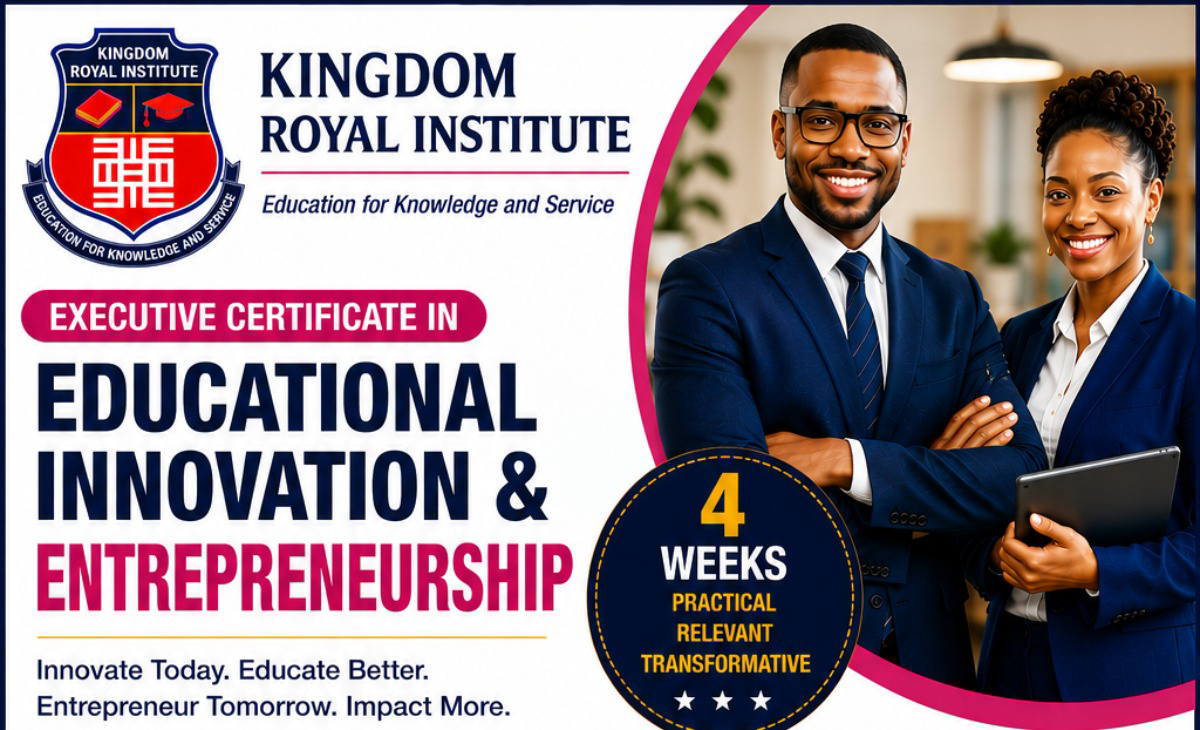
EXECUTIVE CERTIFICATE IN EDUCATIONAL INNOVATION & ENTREPRENEURSHIP
Course Description
The Executive Certificate in Educational Innovation & Entrepreneurship is designed to equip educators, school leaders, administrators and aspiring education entrepreneurs with the knowledge and practical skills required to identify opportunities, develop innovative educational solutions and create sustainable education-related ventures.
The programme explores educational innovation, entrepreneurship, opportunity identification, business models, educational technology, Artificial Intelligence, digital learning, marketing, financial sustainability and change management.
Participants will learn how to transform educational challenges into practical opportunities and develop innovative products, services or initiatives that can improve teaching, learning and educational outcomes.
The programme is particularly relevant to the growing private, technology-enabled and entrepreneurial education sector in Ghana and Africa.
EXECUTIVE CERTIFICATE IN EDUCATIONAL INNOVATION & ENTREPRENEURSHIP
1. Programme Overview
|
Item |
Details |
|
Institution |
Kingdom Royal Institute (KRI) |
|
Programme |
Executive Certificate in Educational Innovation & Entrepreneurship |
|
Duration |
4 Weeks |
|
Frequency |
3 Sessions per Week |
|
Total Sessions |
12 |
|
Session Duration |
2 Hours |
|
Total Contact Hours |
24 Hours |
|
Mode |
Online / Blended |
|
Level |
Executive Professional Development |
|
Award |
KRI Executive Certificate |
|
Fee |
GHC1500.00 |
|
Assessment |
Practical activities, assignments, case studies and innovation project |
2. Course Description
The Executive Certificate in Educational Innovation & Entrepreneurship is designed to equip educators, school leaders, administrators and aspiring education entrepreneurs with the knowledge and practical skills required to identify opportunities, develop innovative educational solutions and create sustainable education-related ventures.
The programme explores educational innovation, entrepreneurship, opportunity identification, business models, educational technology, Artificial Intelligence, digital learning, marketing, financial sustainability and change management.
Participants will learn how to transform educational challenges into practical opportunities and develop innovative products, services or initiatives that can improve teaching, learning and educational outcomes.
The programme is particularly relevant to the growing private, technology-enabled and entrepreneurial education sector in Ghana and Africa.
3. Rationale
The education sector is changing rapidly. Technology, online learning, Artificial Intelligence, changing learner expectations and the growth of private education are creating new opportunities for educators and education entrepreneurs.
Educational professionals increasingly need skills beyond traditional teaching and administration. They need to be able to identify problems, innovate, develop solutions, manage educational ventures and use technology to create value.
This programme therefore introduces participants to practical approaches for becoming innovators, educational entrepreneurs and change agents.
4. Programme Aim
The programme aims to develop innovative and entrepreneurial education professionals who can identify educational opportunities, design practical solutions and use technology and AI to create sustainable educational initiatives.
5. Programme Objectives
By the end of the programme, participants should be able to:
- Explain the concepts of innovation and entrepreneurship in education.
- Identify opportunities and challenges within the education sector.
- Develop innovative solutions to educational problems.
- Apply basic entrepreneurial principles to educational ventures.
- Develop simple business and sustainability models for education initiatives.
- Use technology and AI to support educational innovation.
- Identify potential markets and customers for educational products and services.
- Develop basic marketing strategies for educational ventures.
- Evaluate the financial and operational feasibility of an educational idea.
- Manage innovation and change within educational institutions.
- Develop and present an educational innovation or entrepreneurship project.
6. Learning Outcomes
At the end of the programme, participants will be able to:
- Explain educational innovation and entrepreneurship.
- Identify opportunities in the education sector.
- Conduct basic problem and opportunity analysis.
- Generate innovative educational ideas.
- Design an educational product or service.
- Develop a basic business model.
- Identify target customers and markets.
- Use AI to support idea generation and business planning.
- Apply digital technologies to educational ventures.
- Develop basic financial and sustainability plans.
- Present an educational innovation proposal.
7. Target Participants
The programme is suitable for:
- Teachers
- Headteachers
- School proprietors
- School administrators
- Educational consultants
- Education officers
- University/college lecturers
- Training managers
- EdTech entrepreneurs
- Private education operators
- NGO education programme managers
- Youth entrepreneurs
- Aspiring edupreneurs
- Professionals interested in education businesses
8. Entry Requirements
Applicants should normally possess:
- A minimum of Senior High School (SHS) certificate or equivalent; and
- Relevant professional, educational, entrepreneurial or work experience where applicable.
Applicants with higher qualifications are welcome.
No previous business or entrepreneurship qualification is required.
9. Programme Structure
The programme consists of four modules delivered over four weeks.
Module 1
Understanding Educational Innovation & Entrepreneurship
Module 2
Innovation Design & Educational Technology
Module 3
Building Sustainable Education Ventures
Module 4
Marketing, Growth & Innovation Project
10. Detailed Course Outline
MODULE 1: FOUNDATIONS OF EDUCATIONAL INNOVATION & ENTREPRENEURSHIP
Session 1: Understanding Educational Innovation
Topics
- Meaning of innovation
- Innovation versus improvement
- Types of educational innovation
- Why innovation matters in education
- Examples of educational innovation
Practical
Activity:
Identify three challenges in a Ghanaian school that require innovative
solutions.
Session 2: Educational Entrepreneurship & the Edupreneur
Topics
- Meaning of entrepreneurship
- Meaning of edupreneurship
- Characteristics of an edupreneur
- Education versus edupreneurship
- Opportunities in the education sector
- Examples of education enterprises
Practical
Activity:
Participants identify one educational problem that could become an
entrepreneurial opportunity.
Session 3: AI for Educational Innovation
Topics
- Introduction to AI and Generative AI
- AI as an innovation tool
- AI for idea generation
- AI for educational content development
- AI for business planning
- Ethical and responsible use of AI
Practical
Activity:
Use an AI tool to develop and improve an educational business idea.
MODULE 2: INNOVATION DESIGN & EDUCATIONAL TECHNOLOGY
Session 4: Identifying Problems & Designing Solutions
Topics
- Problem identification
- Needs assessment
- Understanding learners and customers
- Creative thinking
- Design thinking
- Developing solutions
Practical
Activity:
Create a simple solution to an identified educational problem.
Session 5: Educational Technology & Digital Innovation
Topics
- Educational technology
- Online education
- Learning Management Systems
- Mobile learning
- Digital classrooms
- Educational apps and platforms
- AI-powered learning
Practical
Activity:
Design a simple technology-based educational service.
Session 6: From Idea to Educational Product
Topics
- Product and service development
- Minimum Viable Product (MVP)
- Testing an educational idea
- User feedback
- Improving the product
- Measuring educational value
Practical
Activity:
Develop a basic prototype or concept for an educational product/service.
MODULE 3: BUILDING A SUSTAINABLE EDUCATION VENTURE
Session 7: Business Models for Education
Topics
- Understanding business models
- Customers and value propositions
- Revenue models
- Cost structures
- Partnerships
- Business Model Canvas
Practical
Activity:
Develop a simple Business Model Canvas for an education venture.
Session 8: Financial Sustainability & Resource Management
Topics
- Start-up costs
- Operating costs
- Pricing
- Revenue generation
- Break-even concept
- Financial sustainability
- Funding opportunities
Practical
Activity:
Prepare a simple financial plan for an educational venture.
Session 9: Leadership, Teams & Managing Innovation
Topics
- Leading innovation
- Building innovative teams
- Managing change
- Resistance to innovation
- Collaboration
- Partnerships
- Scaling educational initiatives
Practical
Activity:
Develop an implementation plan for introducing an innovation in a school.
MODULE 4: MARKETING, GROWTH & INNOVATION PROJECT
Session 10: Marketing Educational Products & Services
Topics
- Educational markets
- Identifying target customers
- Value proposition
- Branding
- Digital marketing
- Social media marketing
- Customer engagement
Practical
Activity:
Develop a basic marketing plan for an educational product.
Session 11: Innovation Growth & AI-Powered Business Development
Topics
- Scaling an education venture
- Measuring success
- Customer feedback
- Innovation improvement
- AI-assisted marketing
- AI-assisted business analysis
- Digital automation
- Future opportunities in education
Practical
Activity:
Use AI to analyse and improve the participant's proposed education venture.
Session 12: Educational Innovation & Entrepreneurship Project
Participants will present an Educational Innovation or Entrepreneurship Project.
The project should include:
- Problem/opportunity
- Proposed solution
- Target users/customers
- Value proposition
- Technology/AI component
- Business model
- Marketing approach
- Financial sustainability
- Implementation plan
- Expected impact
11. Teaching & Learning Methods
The programme will use a highly practical approach:
- Interactive lectures
- Case studies
- Brainstorming
- Design-thinking activities
- Group discussions
- Business simulations
- AI demonstrations
- Technology demonstrations
- Business Model Canvas exercises
- Project development
- Presentations
- Peer feedback
12. Assessment
|
Assessment Component |
Weight |
|
Participation & practical activities |
10% |
|
Individual assignments |
20% |
|
Case study/problem analysis |
15% |
|
Innovation exercise/group presentation |
15% |
|
Educational Innovation Project |
30% |
|
Final project presentation |
10% |
|
Total |
100% |
13. Final Project
Participants will develop an Educational Innovation & Entrepreneurship Project.
Examples include:
- Online tutoring business
- Educational consultancy
- Teacher training platform
- AI-powered learning service
- Digital school management solution
- Online examination platform
- Educational mobile application
- Private school improvement service
- Professional training institute
- Educational content business
- School transportation or support service
- Digital library/learning resource platform
14. Certification Requirements
Participants qualify for the KRI Executive Certificate in Educational Innovation & Entrepreneurship upon:
- Attending at least 80% of sessions
- Completing required assignments
- Participating in practical activities
- Completing the innovation project
- Presenting the final project
- Achieving the required pass mark
15. Graduate Profile
A successful participant should be able to:
Identify educational opportunities, develop innovative solutions, apply technology and AI, design sustainable education ventures and lead innovation within educational institutions.